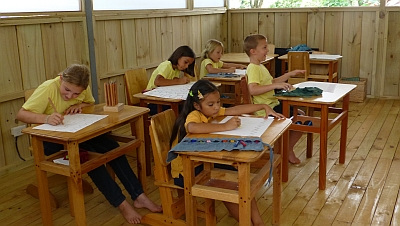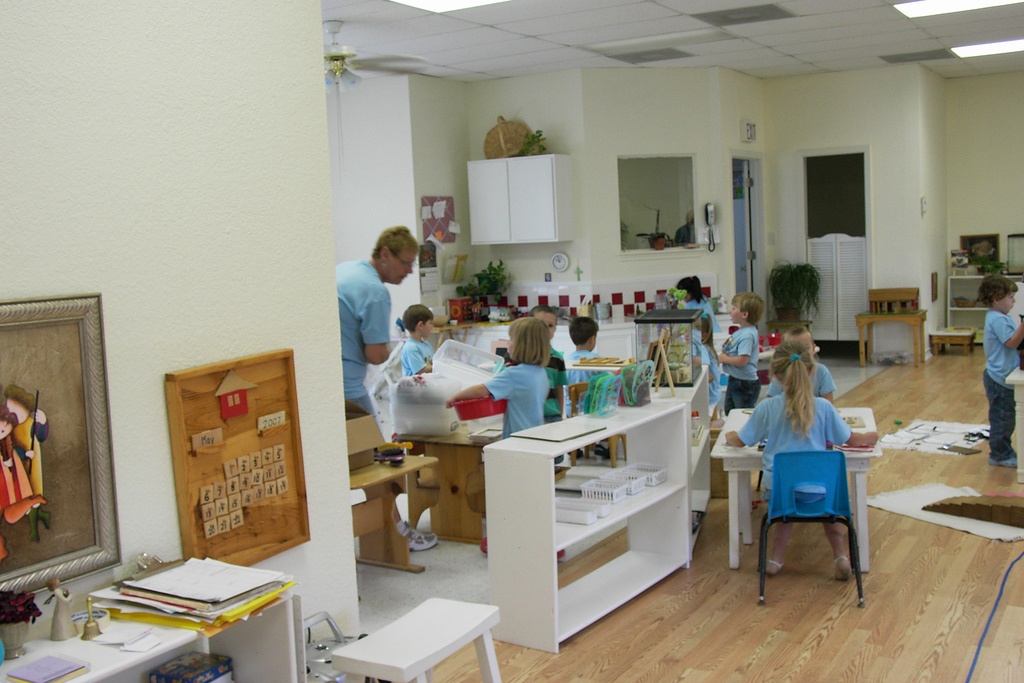
When Romania reopened its borders to foreign educational models after 1989, Montessori was among the first frameworks to arrive. The environment — a carefully arranged room of wooden materials, low shelves, and children moving at their own pace — was unfamiliar enough to attract attention and familiar enough, in its emphasis on order and concrete learning, to resonate with Romanian educators looking for structured alternatives to the Soviet-influenced curriculum they had inherited.
Three decades later, the Montessori presence in Romania is documented, if modest in absolute numbers. The Association Montessori Internationale (AMI) has certified trainers operating in the country, and a network of private Montessori nurseries, kindergartens, and primary-level environments has expanded steadily in Bucharest, Cluj-Napoca, Iași, and Timișoara. This article examines that presence: how it developed, what distinguishes authentic implementations from looser adaptations, and what patterns are visible in the documented record.
Arrival and Early Adoption
The first identifiable Montessori environments in Romania date to the mid-1990s. They were established primarily by parents who had encountered the approach abroad or through translated texts, and by early-childhood educators who received AMI-affiliated training in Western Europe. The legal framework at the time was permissive enough to allow private kindergartens to operate with considerable methodological autonomy, which meant that the Montessori label was applied broadly — and not always accurately.
A clearer distinction between licensed and unlicensed use of the Montessori name emerged in the 2000s as AMI representatives began visiting Romanian environments and as a small number of local educators completed the full AMI 3–6 diploma course in Vienna, Bergamo, and Amsterdam. These trained guides returned with the precise vocabulary of Montessori pedagogy: the three-period lesson, the control of error built into the materials, the preparation of the adult as the core of classroom management.
What a Documented Montessori Environment Contains
An AMI-affiliated Montessori 3–6 environment in Romania will typically contain the following material areas, documented in AMI training manuals and confirmed by classroom observations published in Romanian pedagogical journals:
Practical Life
Activities drawn from the daily domestic environment: pouring, spooning, folding, buttoning, and more complex tasks such as food preparation. The exercises develop fine motor coordination, concentration, and the habit of completing a cycle of activity. Romanian implementations frequently include local domestic materials — clay vessels, traditional cloth textures — alongside the standard AMI materials.
Sensorial Materials
The wooden apparatus designed by Montessori to isolate single qualities — colour, weight, texture, temperature, pitch, dimension — and allow children to build a precise internal vocabulary for the physical world. The pink tower, the broad stair, the cylinder blocks, and the colour tablets are found in consistent form across licensed Romanian environments.
Language
The sandpaper letters, the moveable alphabet, and the phonogram material are adapted to Romanian phonology. Romanian, a phonetically consistent Romance language, maps well onto the Montessori phonemic-awareness sequence. Classroom documentation from Bucharest environments notes that children typically complete the reading sequence several months faster in Romanian than AMI timelines developed for English-speaking children.
Mathematics
The golden bead material introduces the decimal system concretely; the stamp game, bead chains, and racks and tubes extend operations through long multiplication and division. Romanian Montessori primary classes documented through the 2010s show children completing these sequences independently at ages seven and eight, with teachers functioning as observers and material presenters rather than group instructors.
Adaptation Within State Schools
Alongside private Montessori nurseries and kindergartens, a small number of Romanian state schools have incorporated Montessori-derived practices into public-sector classrooms. These hybrid implementations are formally distinct from AMI-certified environments but represent a documented channel through which Montessori ideas have reached children outside the fee-paying private sector.
The Ministry of Education's 2016 curriculum reform explicitly referenced "alternative and complementary pedagogical approaches" as permissible within the flexibility bands of the national curriculum. Several county school inspectorates documented pilot programs in which state kindergarten teachers attended Montessori introduction courses funded by EU structural funds between 2015 and 2020.
The results of these pilots are recorded in inspection reports rather than peer-reviewed studies, so methodological caution is appropriate. The reports note higher rates of on-task engagement and reduced teacher-initiated transitions, but do not control for selection effects in the participating schools.
The 6–12 Age Range: A Documented Gap
AMI Montessori education extends through three developmental planes: 0–6, 6–12 (the Elementary level), and 12–18. In Romania, the documented presence of Elementary Montessori environments is thin. The handful of primary-age Montessori classrooms that exist operate informally, often within private schools that use the Montessori label for the early childhood section but revert to more standard instruction once children enter statutory primary-school age at six.
This gap is not unique to Romania. Elementary Montessori requires a different, longer AMI training and a fundamentally reorganised curriculum built around the "Great Lessons" — narrative cosmological stories that frame all academic subjects. The training infrastructure for Elementary work in Eastern Europe remains underdeveloped compared to that for the 3–6 level.
Current Landscape
As of 2026, the Romanian Montessori landscape includes approximately 30–40 private nurseries and kindergartens that use the Montessori name, of which a subset — estimated in the low dozens — maintain some level of connection to formal AMI training or supervision. Several professional networks, including the Romanian Montessori Association, publish materials and organise parent-education events in Romanian.
The concentration in urban centres remains pronounced. A parent seeking a licensed Montessori environment for their child in Bucharest, Cluj-Napoca, or Timișoara has several documented options. A parent in a secondary city or rural commune currently has none on the documented record.
External references: AMI Montessori International provides global directory listings and training standards. The Romanian Ministry of Education publishes inspection frameworks that govern alternative school accreditation.